
Project Overview
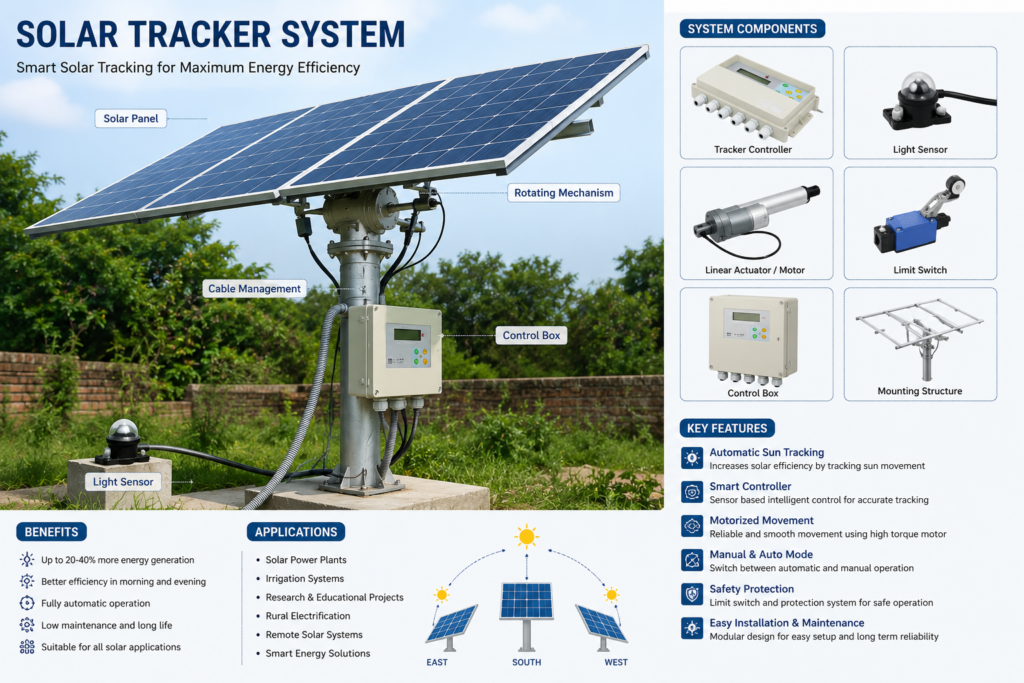
AXION ES works on solar tracker system design, installation, controller integration, troubleshooting, and commissioning for solar power applications. A solar tracker system is designed to improve solar panel performance by adjusting the panel position according to the movement of the sun.
Unlike fixed solar panel structures, a tracker can move the solar panel array during the day to maintain a better angle toward sunlight. This helps increase solar energy generation, especially in open-space solar projects, research installations, irrigation systems, institutional solar plants, and special renewable energy demonstration projects.
This project represents AXION ES’s capability in solar tracking mechanism installation, sensor-based control, motorized panel movement, wiring, control box setup, and field testing.
Problem
In a fixed solar panel system, panels remain in one position throughout the day. Because the sun changes position from morning to evening, fixed panels cannot always receive sunlight at the best angle.
This can create several limitations:
- Lower energy generation during morning and afternoon
- Less efficient use of available sunlight
- Reduced output in research or demonstration systems
- No automatic panel angle adjustment
- Manual adjustment difficulty
- Need for better solar performance optimization
- Requirement for proper controller and motor integration
For certain projects, especially where maximum solar harvesting is important, a solar tracker can provide better performance than a fixed mounting system.
AXION ES Recommended Solution
AXION ES provides solar tracker system development and technical support based on the client’s project requirement. The system can be designed using a motorized tracking mechanism, controller unit, light sensor or programmed solar position logic, and proper electrical wiring.
The solution may include:
- Solar tracker controller installation
- Light sensor-based tracking
- Motorized panel movement control
- Single-axis or dual-axis tracking concept
- Solar panel mounting structure integration
- Actuator or motor control system
- Control box wiring
- Limit switch and safety control
- Manual and automatic mode option
- Tracker calibration
- Field testing and commissioning
- Maintenance and troubleshooting support
The system is designed to keep the solar panel array in a better orientation toward sunlight and improve daily energy collection.
How the Solar Tracker Works
A solar tracker system moves the solar panel structure according to sunlight direction. The controller receives input from sensors or programmed tracking logic and then activates the motor or actuator to adjust the panel position.
Basic operation process:
- Solar tracker controller checks sunlight direction or tracking algorithm
- Controller compares the current panel position with the desired position
- Motor or actuator rotates the panel frame
- Limit switch or position feedback protects the system from over-movement
- Panel remains aligned for improved sunlight capture
- The system continues adjustment throughout the day
- At the end of the day, the tracker can return to a starting position if programmed
This automatic movement helps the panel receive more direct sunlight compared with a fixed structure.
Key Features
Automatic Solar Tracking
The system can automatically adjust panel direction based on sunlight or pre-programmed movement logic.
Improved Solar Generation
By keeping the panel at a better angle toward the sun, the system can increase daily solar energy production compared with a fixed panel setup.
Controller-Based Operation
A dedicated controller manages motor movement, sensor input, timing, direction, and safety logic.
Motorized Movement
The solar panel structure can be moved using a motor, actuator, or geared tracking mechanism depending on load and design.
Manual and Auto Mode
The system can include both automatic tracking and manual control options for testing, maintenance, and emergency operation.
Safety and Limit Protection
Limit switches, mechanical stops, overload protection, and proper wiring can be added to protect the tracker from over-rotation or abnormal operation.
Field Calibration
The tracker can be calibrated according to site position, panel angle, motor direction, and movement range.
Customizable Design
AXION ES can customize the tracker system for different panel sizes, frame designs, motor types, controller types, and site requirements.
Possible Technical Components
A solar tracker system may include:
- Solar tracker controller
- Light sensor or sun position sensor
- DC motor or actuator
- Motor driver or relay module
- Limit switches
- Position feedback sensor
- Control panel or junction box
- Solar panel mounting frame
- Rotating mechanism
- Cable management system
- Manual control switch
- Power supply system
- Protection devices
- Earthing and safety components
The final component selection depends on panel capacity, structure design, wind load, movement type, and project budget.
Application Areas
AXION ES solar tracker systems can be used in:
- Solar research projects
- Educational renewable energy labs
- Solar irrigation systems
- Open-field solar installations
- Demonstration solar plants
- Agricultural solar projects
- Institutional solar systems
- Smart energy projects
- Experimental solar power systems
- Remote off-grid solar applications
Benefits of Solar Tracker System
A properly designed solar tracker system can provide several benefits:
- Better sunlight capture
- Higher daily solar energy generation
- Improved morning and afternoon output
- More efficient use of solar panels
- Automatic panel orientation
- Useful for research and demonstration
- Better performance optimization
- Smart renewable energy operation
- Future-ready solar technology platform
For selected applications, solar tracking can improve system performance and demonstrate advanced renewable energy engineering.
AXION ES Engineering Capability
AXION ES has practical experience in solar EPC, embedded systems, automation, motor control, sensor integration, control panel wiring, and custom engineering design. This makes us capable of developing and supporting solar tracking systems from mechanical integration to controller commissioning.
Our support may include:
- Solar tracker concept development
- Mechanical movement planning
- Controller setup
- Motor and actuator integration
- Sensor installation
- Control box wiring
- Limit switch setup
- Troubleshooting and repair
- Field calibration
- Testing and commissioning
- Maintenance support
- Future upgrade support
Expected Outcome
After installation and commissioning, the solar tracker system can help achieve:
- Improved panel orientation
- Better solar energy harvesting
- Automated tracking operation
- Reduced need for manual angle adjustment
- Better solar project demonstration value
- More intelligent solar power system operation
- Reliable motorized panel movement
- Safer and more organized tracker control
Why Choose AXION ES?
AXION ES provides practical engineering solutions for solar, automation, embedded control, and industrial technology projects. We can support both new solar tracker development and existing tracker troubleshooting.
Our strengths include:
- Solar engineering experience
- Automation and motor control expertise
- Sensor-based system design
- Controller wiring and commissioning
- Field installation support
- Custom control system development
- Local technical service
- Practical problem-solving approach
- Future-ready design capability
Conclusion
A Solar Tracker System is an intelligent solar technology that improves panel positioning and helps increase solar energy harvesting. It is suitable for research projects, irrigation systems, open-field installations, educational demonstrations, and advanced renewable energy applications.
AXION ES can provide complete support for solar tracker system design, controller integration, motorized movement control, wiring, calibration, troubleshooting, and commissioning.
By combining solar engineering with automation expertise, AXION ES can deliver practical and reliable solar tracking solutions for modern renewable energy projects.