
Project Overview
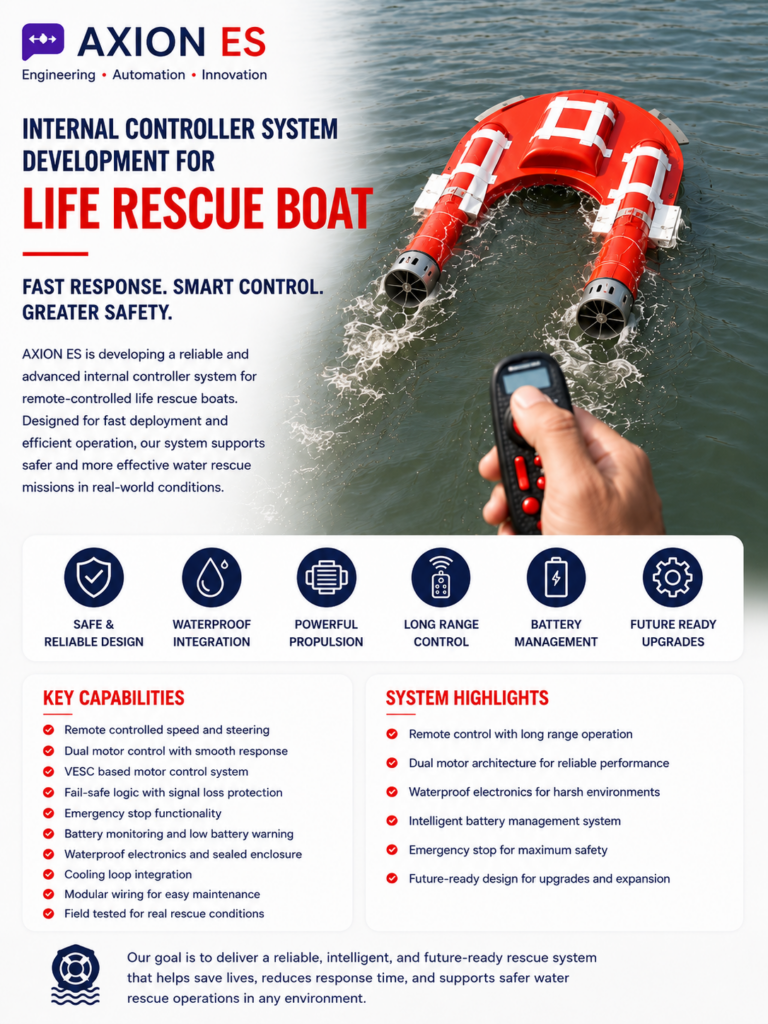
AXION ES is developing an internal controller system for a remote-controlled life rescue boat / rescue buoy platform for professional water rescue applications. The system is being developed with a focus on reliable propulsion control, waterproof electronics, battery management, safety logic, field testing, and future upgrade capability.
This type of rescue device is designed to quickly move through water and reach a person in distress. It can help rescue teams provide flotation support and guidance from a safer distance, especially in rivers, lakes, coastal areas, flood situations, and emergency rescue operations.
The project is planned for a Bangladesh Navy-related rescue application, where reliability, durability, control accuracy, and real-world field performance are very important.
AXION ES is responsible for developing the internal control system and engineering integration support, including electrical integration, controller setup, propulsion control, waterproofing strategy, and testing support.
Project Objective
The main objective of this project is to develop a functional prototype of a remote-controlled rescue boat with a reliable internal controller system.
The controller system will be designed to manage:
- Motor and propulsion control
- Battery power distribution
- Remote command reception
- Steering and speed control
- Safety and fail-safe logic
- Waterproof electrical integration
- VESC parameter setup
- Cooling loop integration
- Pool testing and field trial support
- Future upgrade readiness
The target is to prepare a prototype-ready system through a structured design, procurement, fabrication, electrical integration, testing, and field validation process.
Problem Statement
In water rescue operations, time and safety are critical. Conventional rescue methods may require a rescuer, boat, rope, or direct physical entry into the water. In difficult conditions such as current, distance, floodwater, poor visibility, or unsafe surroundings, direct rescue can become risky.
A remote-controlled rescue boat can reduce risk by allowing operators to send a floating rescue platform toward the victim from a safer location.
However, to make the system reliable for professional use, the internal controller must be carefully designed. Common technical challenges include:
- Waterproofing of internal electronics
- Reliable motor control under load
- Stable battery power management
- Proper wiring and sealing
- Motor driver and VESC setup
- Signal loss safety response
- Emergency stop function
- Steering calibration
- Runtime and thrust validation
- Cooling and heat management
- Field serviceability
- Durability in real water conditions
Without a properly engineered internal controller system, a rescue platform may fail during operation, lose communication, suffer electrical damage, or perform inconsistently in water.
AXION ES Recommended Solution
AXION ES is developing a custom internal controller system that can be integrated into the life rescue boat hull. The system will control propulsion motors, manage battery power, receive remote operator commands, and support safe operation during rescue use.
The proposed solution includes:
- CAD-supported controller and mounting layout
- Hull, ducting, mounting, and sealing design support
- Motor and ESC integration
- Battery and radio system integration
- Waterproof wiring and connector planning
- VESC parameter setup
- Internal cooling loop arrangement
- Safety testing
- Pool testing
- River field trial support
- Performance data reporting
The goal is to create a prototype that is practical, serviceable, and suitable for further field development.
Proposed Work Plan
The project will follow a structured multi-phase development plan. This phased approach will help reduce technical risk and allow the team to validate each major part of the system before final field trials.
Phase-wise Development Details
Phase 1 – Design Finalization
In the first phase, the mechanical design will be finalized. This includes CAD modeling of the hull, ducting, internal mounting position, controller placement, and sealing approach.
This phase is important because the electronic controller, battery, motor wiring, ducted propulsion system, and waterproofing strategy must be planned before fabrication and integration.
Key focus areas:
- Hull layout review
- Ducting design
- Internal mounting position
- Sealing design
- Maintenance access planning
- Controller and battery placement
- Space planning for wiring and cooling
Phase 2 – Procurement and Fabrication
After design finalization, the required parts will be sourced and fabricated. This includes motors, ESCs, batteries, radio communication components, and required mounting hardware.
This stage also includes fabrication of motor mounts and internal support structure so that the control system can be installed securely inside the rescue boat.
Key focus areas:
- Motor sourcing
- ESC sourcing
- Battery sourcing
- Radio system sourcing
- Mount fabrication
- Mechanical fitting preparation
- Component compatibility checking
Phase 3 – Electrical Integration
In this phase, AXION ES will perform the internal electrical integration work. This includes wiring, waterproofing, VESC parameter setup, cooling loop integration, and controller connection.
This is one of the most important phases because the rescue boat must operate safely in a wet environment. Proper cable routing, sealing, power distribution, and protection planning are essential for stable operation.
Key focus areas:
- Internal wiring
- Waterproof cable routing
- Connector and sealing work
- VESC parameter setup
- Battery and power distribution
- Receiver and controller connection
- Cooling loop integration
- System protection planning
- Initial bench testing
Phase 4 – Pool Testing
After electrical integration, the prototype will go through controlled pool testing. This phase will validate basic movement, thrust, runtime, steering response, and safety behavior before open-water testing.
Pool testing allows the team to observe the system in a safer and more controlled environment.
Key focus areas:
- Thrust validation
- Runtime checking
- Steering calibration
- Motor response testing
- Remote control response
- Emergency stop testing
- Waterproofing observation
- Safety testing
Phase 5 – Field Trials and Reporting
After successful pool testing, the system will be tested in river or real-water rescue trial conditions. This phase will help validate actual field performance and collect operational data.
A final report will be prepared based on test results, performance data, observations, and future improvement recommendations.
Key focus areas:
- River rescue trial
- Real water movement test
- Operator control assessment
- Runtime and power observation
- Steering performance
- Stability observation
- Performance data collection
- Final reporting
Key Features of the Internal Controller System
The internal controller system may include:
- Remote-controlled propulsion
- Dual motor control support
- Differential steering control
- VESC-based motor control setup
- Battery power management
- Low battery warning option
- Emergency stop function
- Signal loss safety logic
- Waterproof electronics housing
- Protected power wiring
- Cooling loop support
- Modular wiring design
- Field maintenance-friendly layout
- Future telemetry and GPS upgrade readiness
Future Development Roadmap
The prototype is planned as a foundation for future development. After the initial prototype and field trials, the system can be upgraded in stages.
| Version | Upgrade | Description |
|---|---|---|
| V2.0 | GPS Autopilot | Auto-return and path tracking |
| V2.1 | Live Telemetry | Real-time video and battery data link |
| V3.0 | AI Navigation | Object detection and auto-target tracking |
Future Upgrade Possibilities
V2.0 – GPS Autopilot
The next stage may include GPS-based navigation. This can allow the rescue boat to follow a predefined path, return automatically, or support guided rescue operation with improved navigation assistance.
Possible features:
- GPS position tracking
- Auto-return function
- Path tracking
- Waypoint-based movement
- Operator-assisted navigation
V2.1 – Live Telemetry
Live telemetry can improve operator awareness during rescue missions. A real-time data link can provide battery status, system condition, and video feedback.
Possible features:
- Real-time battery data
- Live video link
- Motor status feedback
- Signal strength monitoring
- Runtime information
- Operator dashboard
V3.0 – AI Navigation
In a more advanced version, AI-based navigation may support object detection and target tracking. This can help the rescue boat identify a target area and assist the operator in guiding the device more effectively.
Possible features:
- Object detection
- Auto-target tracking
- Assisted rescue navigation
- Smart movement correction
- Obstacle awareness concept
Application Areas
This life rescue boat controller system can be useful for:
- Navy rescue operations
- River rescue missions
- Flood rescue support
- Coast guard and maritime applications
- Fire service and civil defense
- Disaster response teams
- Training and simulation
- Lake and resort safety
- Emergency response organizations
- Industrial water area safety
Bangladesh has many rivers, coastal zones, flood-prone areas, and water-based operational environments. A reliable remote rescue platform can provide strong practical value for emergency rescue teams.
AXION ES Engineering Capability
AXION ES has experience in embedded electronics, motor control, robotics, industrial automation, solar systems, and custom R&D product development. This project reflects our capability to work on practical engineering challenges where mechanical design, electronics, firmware, waterproofing, and field testing must work together.
Our relevant capabilities include:
- Embedded controller development
- Motor control system integration
- VESC and ESC integration
- Battery-powered system design
- Waterproof electronics planning
- Remote-control system integration
- Custom PCB and wiring design
- Firmware and control logic development
- Prototype testing
- CAD-supported product development
- Field trial support
- Custom R&D project execution
Expected Outcome
The expected outcome of this project is a prototype-ready life rescue boat controller system within an estimated 11-week development timeline.
Expected benefits include:
- Functional remote-controlled rescue boat prototype
- Reliable internal controller system
- Improved rescue response support
- Safer operation for rescue teams
- Controlled speed and steering
- Waterproof electrical integration
- Battery and power management
- Validated thrust and runtime performance
- Pool-tested and field-trial-ready system
- Future upgrade path for GPS, telemetry, and AI navigation
Why This Project Matters
Water rescue is time-sensitive. A remote-controlled rescue boat can help rescue teams reach a person in distress faster while reducing direct risk to rescuers.
For professional organizations, this type of technology can improve rescue readiness, training capability, and operational response. Local development of the controller system also helps build advanced engineering capability in Bangladesh.
AXION ES aims to support this development through practical design, integration, testing, and future-ready engineering.
Conclusion
AXION ES is developing an internal controller system for a remote-controlled life rescue boat platform intended for professional water rescue applications. The development plan includes design finalization, procurement, fabrication, electrical integration, pool testing, field trials, and final reporting.
The current prototype plan is structured over 11 weeks, with future roadmap options including GPS autopilot, live telemetry, and AI navigation.
This project demonstrates AXION ES’s capability in custom R&D, embedded control systems, motor control, waterproof electronics, field testing, and advanced rescue technology development.
For organizations looking to develop marine rescue devices, robotic platforms, custom controller systems, or specialized engineering prototypes, AXION ES can provide complete technical support from concept to prototype.